> ## Documentation Index
> Fetch the complete documentation index at: https://gofastmcp.com/llms.txt
> Use this file to discover all available pages before exploring further.
# Form Input
> Collect structured data from users via Pydantic models
export const VersionBadge = ({version}) => {
return
New in version {version}
;
};
`FormInput` generates a validated form from a Pydantic model. The user fills it out, and the submission is validated against the model before being returned. Structured elicitation that can't be hallucinated.
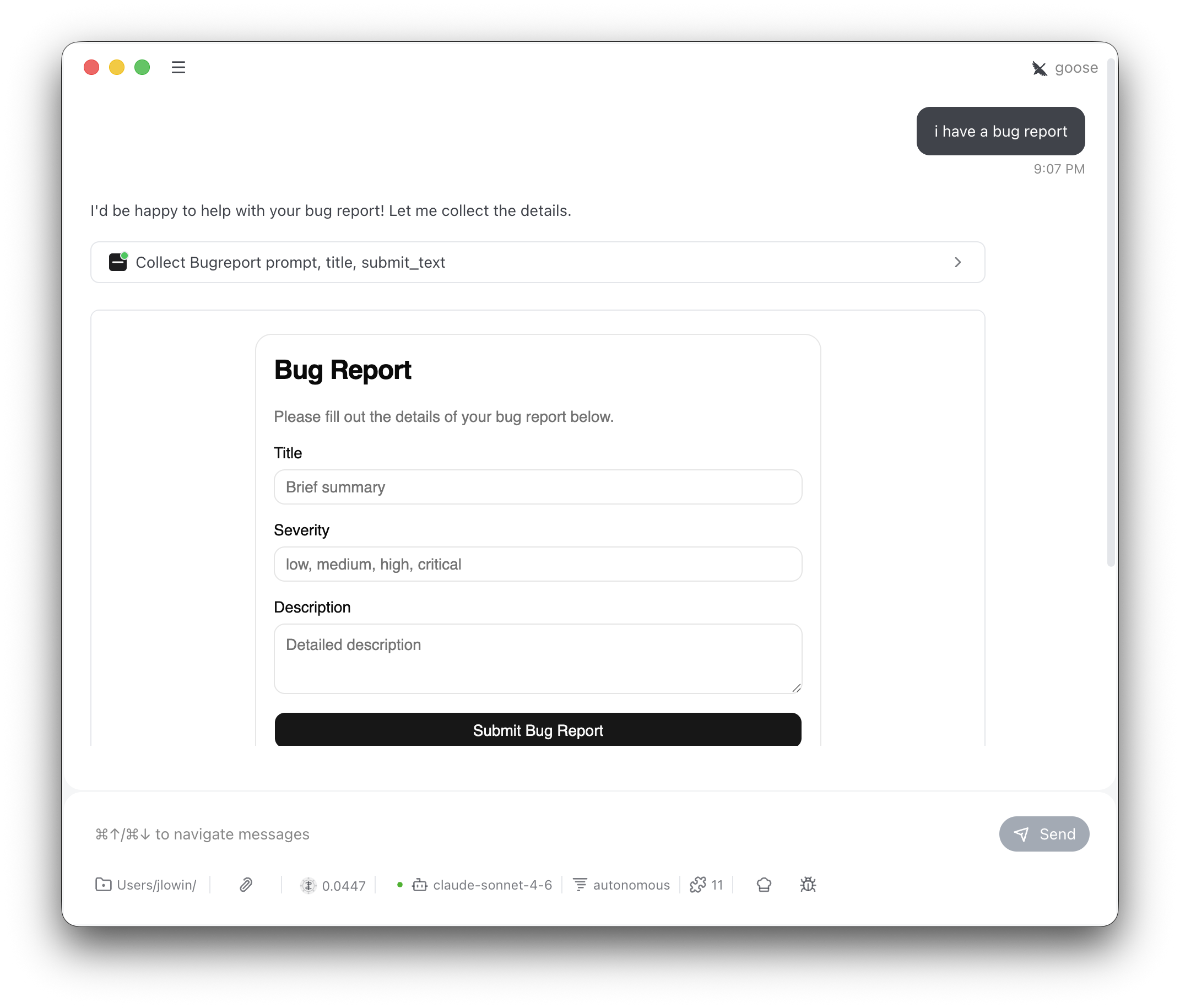 ```python theme={"theme":{"light":"snazzy-light","dark":"dark-plus"}}
from typing import Literal
from pydantic import BaseModel, Field
from fastmcp import FastMCP
from fastmcp.apps.form import FormInput
class BugReport(BaseModel):
title: str = Field(description="Brief summary")
severity: Literal["low", "medium", "high", "critical"]
description: str = Field(
description="Detailed description",
json_schema_extra={"ui": {"type": "textarea"}},
)
mcp = FastMCP("My Server")
mcp.add_provider(FormInput(model=BugReport))
```
This registers two tools:
| Tool | Visibility | Purpose |
| ------------------- | ---------- | -------------------------------------- |
| `collect_bugreport` | Model | Opens the form UI |
| `submit_form` | App only | Validates and processes the submission |
The tool name is derived from the model class name, lowercased: `collect_{modelname}`. So `BugReport` becomes `collect_bugreport`, `ShippingAddress` becomes `collect_shippingaddress`. Use `tool_name` to override if needed. The LLM calls it with a prompt explaining what it needs, and the user gets a form with fields matching the model.
## Field mapping
`FormInput` uses Prefab's `Form.from_model()`, which maps Pydantic types to form components:
| Python type | Form component |
| --------------- | --------------- |
| `str` | Text input |
| `int`, `float` | Number input |
| `bool` | Checkbox |
| `datetime.date` | Date picker |
| `Literal[...]` | Select dropdown |
| `SecretStr` | Password input |
Use `Field()` metadata to control labels (`title`), placeholders (`description`), and validation (`min_length`, `max_length`, `ge`, `le`). Use `json_schema_extra={"ui": {"type": "textarea"}}` for multiline text.
## Callback
By default, the validated model is returned as JSON. Provide an `on_submit` callback to process the data server-side:
```python theme={"theme":{"light":"snazzy-light","dark":"dark-plus"}}
def save_report(report: BugReport) -> str:
db.insert(report.model_dump())
return f"Bug #{db.last_id} filed: {report.title}"
mcp.add_provider(FormInput(model=BugReport, on_submit=save_report))
```
The callback receives a validated model instance and returns a string that becomes the tool result.
## Configuration
```python theme={"theme":{"light":"snazzy-light","dark":"dark-plus"}}
FormInput(
model=BugReport, # Required: the Pydantic model
name="BugTracker", # App name (default: model name)
title="File a Bug", # Card heading (default: model name)
tool_name="file_bug", # Tool name (default: collect_{model})
submit_text="Submit Report", # Button label (default: "Submit")
on_submit=save_report, # Optional callback
send_message=True, # Push result as a chat message
)
```
Set `send_message=True` to push the result back into the conversation via `SendMessage`, triggering the LLM's next turn. Without it, the result is just the tool return value.
## Multiple forms
Add multiple providers for different models — each gets its own tool:
```python theme={"theme":{"light":"snazzy-light","dark":"dark-plus"}}
mcp = FastMCP(
"My Server",
providers=[
FormInput(model=ShippingAddress),
FormInput(model=BugReport),
FormInput(model=ContactInfo),
],
)
```
```python theme={"theme":{"light":"snazzy-light","dark":"dark-plus"}}
from typing import Literal
from pydantic import BaseModel, Field
from fastmcp import FastMCP
from fastmcp.apps.form import FormInput
class BugReport(BaseModel):
title: str = Field(description="Brief summary")
severity: Literal["low", "medium", "high", "critical"]
description: str = Field(
description="Detailed description",
json_schema_extra={"ui": {"type": "textarea"}},
)
mcp = FastMCP("My Server")
mcp.add_provider(FormInput(model=BugReport))
```
This registers two tools:
| Tool | Visibility | Purpose |
| ------------------- | ---------- | -------------------------------------- |
| `collect_bugreport` | Model | Opens the form UI |
| `submit_form` | App only | Validates and processes the submission |
The tool name is derived from the model class name, lowercased: `collect_{modelname}`. So `BugReport` becomes `collect_bugreport`, `ShippingAddress` becomes `collect_shippingaddress`. Use `tool_name` to override if needed. The LLM calls it with a prompt explaining what it needs, and the user gets a form with fields matching the model.
## Field mapping
`FormInput` uses Prefab's `Form.from_model()`, which maps Pydantic types to form components:
| Python type | Form component |
| --------------- | --------------- |
| `str` | Text input |
| `int`, `float` | Number input |
| `bool` | Checkbox |
| `datetime.date` | Date picker |
| `Literal[...]` | Select dropdown |
| `SecretStr` | Password input |
Use `Field()` metadata to control labels (`title`), placeholders (`description`), and validation (`min_length`, `max_length`, `ge`, `le`). Use `json_schema_extra={"ui": {"type": "textarea"}}` for multiline text.
## Callback
By default, the validated model is returned as JSON. Provide an `on_submit` callback to process the data server-side:
```python theme={"theme":{"light":"snazzy-light","dark":"dark-plus"}}
def save_report(report: BugReport) -> str:
db.insert(report.model_dump())
return f"Bug #{db.last_id} filed: {report.title}"
mcp.add_provider(FormInput(model=BugReport, on_submit=save_report))
```
The callback receives a validated model instance and returns a string that becomes the tool result.
## Configuration
```python theme={"theme":{"light":"snazzy-light","dark":"dark-plus"}}
FormInput(
model=BugReport, # Required: the Pydantic model
name="BugTracker", # App name (default: model name)
title="File a Bug", # Card heading (default: model name)
tool_name="file_bug", # Tool name (default: collect_{model})
submit_text="Submit Report", # Button label (default: "Submit")
on_submit=save_report, # Optional callback
send_message=True, # Push result as a chat message
)
```
Set `send_message=True` to push the result back into the conversation via `SendMessage`, triggering the LLM's next turn. Without it, the result is just the tool return value.
## Multiple forms
Add multiple providers for different models — each gets its own tool:
```python theme={"theme":{"light":"snazzy-light","dark":"dark-plus"}}
mcp = FastMCP(
"My Server",
providers=[
FormInput(model=ShippingAddress),
FormInput(model=BugReport),
FormInput(model=ContactInfo),
],
)
```